Three Load Limits, Not One “Heavy Duty” Line
Stack a dryer, a clipper case, and eight retail bottles on the tabletop: rated 66 lbs. The shelf below takes 44 lbs of backstock, the drawer 22 lbs of shears you reach for hourly.
Tired of “heavy duty” with no number behind it? RESHABLE rates the tabletop, shelf, and drawer apart — 4.2★ across 277 verified buyer reviews.
Weigh the dryer you own against a printed 66 lb tabletop rating, not against the word sturdy.
Stack a dryer, a clipper case, and eight retail bottles on the tabletop: rated 66 lbs. The shelf below takes 44 lbs of backstock, the drawer 22 lbs of shears you reach for hourly.
Owners with no flat-pack experience stood a station up in roughly 3 to 4 hours, working from hardware bags labeled one part at a time.
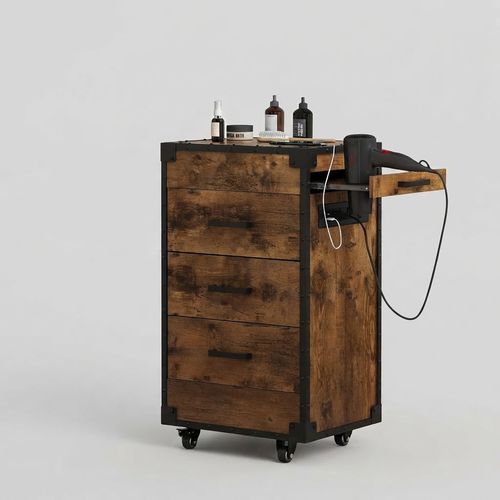
A dryer and a curling iron run off the rolling trolley at the same time. Its 6 ft cable reaches the wall, so no cord crosses your walkway.
Turn the key before you leave a shared locker room. The key-lock drawer sits sized for shears, clippers, and a phone, and classmates borrow only what stays open.
Most-used tools live in the top drawer, a half-turn from the chair, so a cut-and-style stops costing you two walks across the room.
You get back the walkable square yard when the work surface hangs off the wall instead of standing on it. The 30-day return window covers you if the station arrives deeper than the walkway allows.
Wall-mount, freestanding, rolling, and the mirror that hangs beside them. Pick the format your floor plan allows.
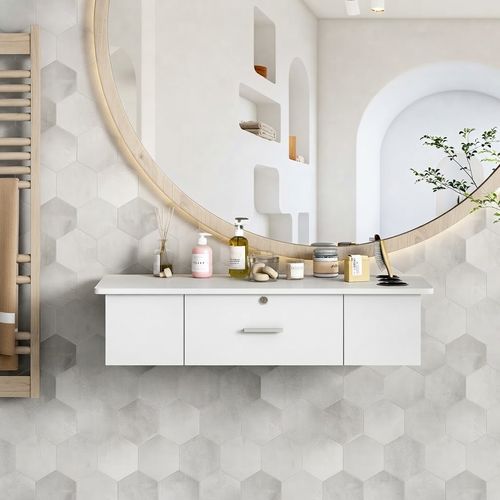
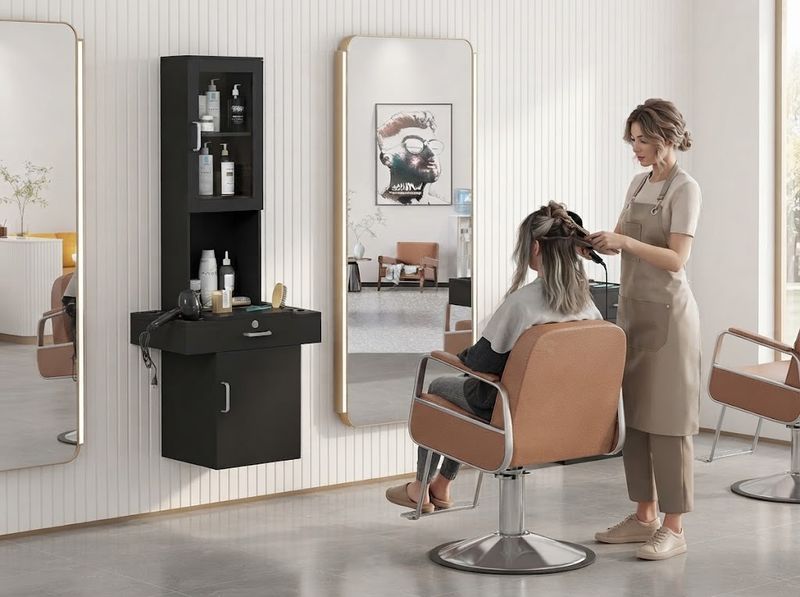
Hang the whole work surface over the chair and the floor beneath it stays walking room. A fat dryer barrel and a slim flat iron each drop into one of six heat-resistant tabletop holders sized for it, instead of cooling on wood. Glass-door shelves keep combs visible and dust off them, and the keyed drawer takes shears out of circulation when you step away. Two side cabinets unclip if your wall run is short. Where a floor cart eats a square yard of a rented suite, this unit spans 23 inches of wall. Mid tier of the wall-mount formats, it lands between the 30 lb starter unit and the 89 lb flagship on your bracket wall.
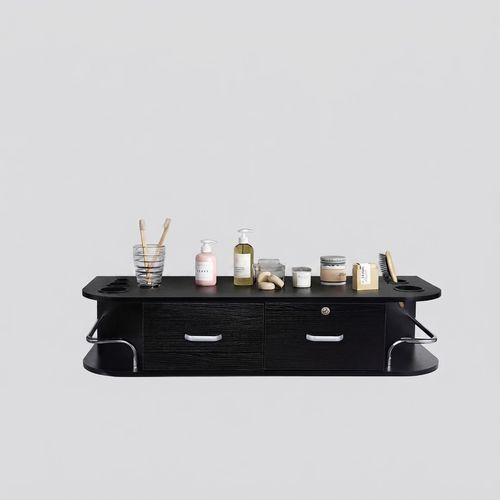
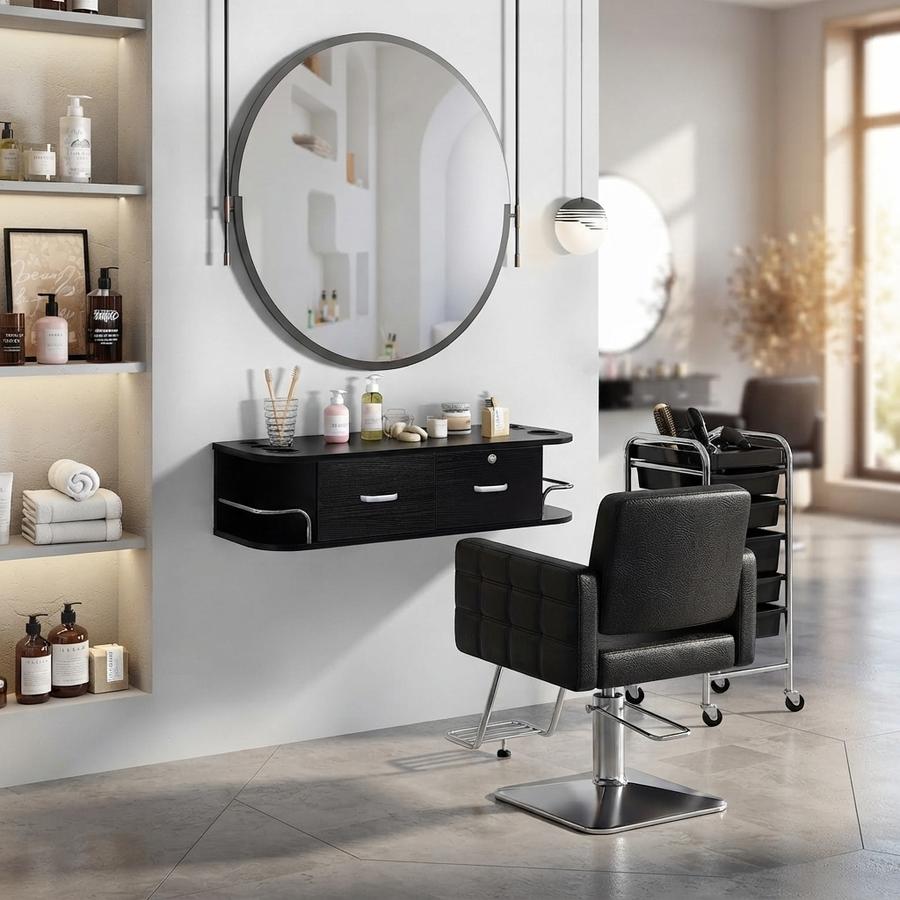
Bolt a 42-inch work surface to the wall at elbow height and the room under it stays empty. Two full-width drawers slide on silver handles, one of them keyed, and stainless retaining bars run both sides so a clipper does not walk off the edge mid-fade. The top is rated to 66 lbs, which covers a dryer, a clipper set, and a row of retail bottles. Where a full cabinet claims 15 inches of floor depth, this piece projects 9 inches off the wall and nothing else. Buyers rate it 4.5★ across 23 reviews. Test the drawer lock inside the 30-day return window through the retailer.
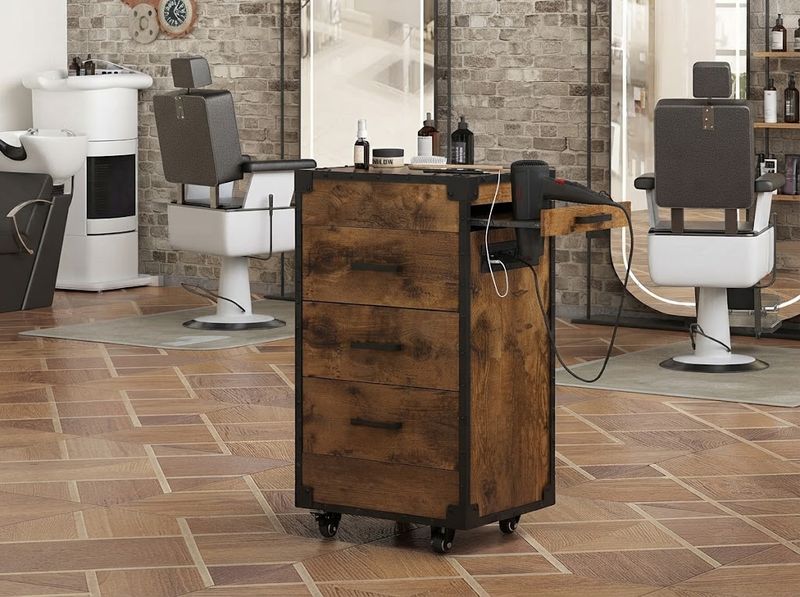
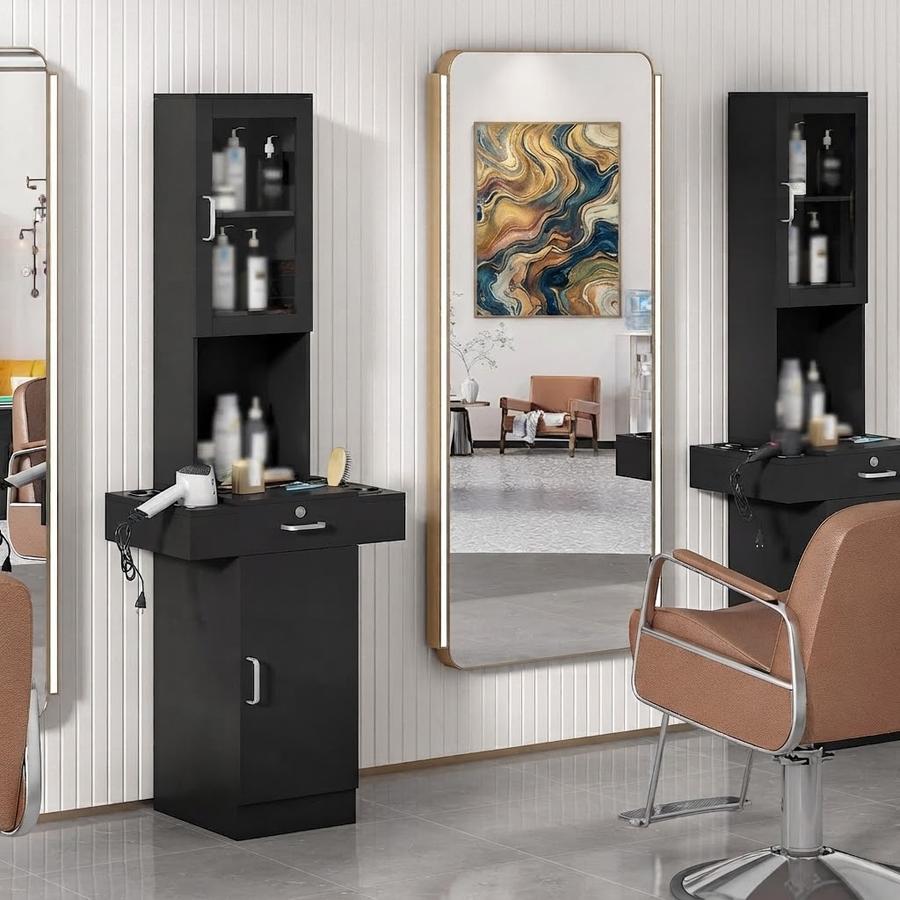
Set a gallon of developer on the cabinet top at 66 lbs, capes on a 44 lb shelf, shears in the 22 lb drawer: an 89 lb body of P2 MDF wrapped in iron tube sits under all three. Adjustable metal foot mats level it on a 40-year-old salon floor in about five minutes, without scratching the finish. Three drawers swallow towels and color tubes while the countertop holds three heat-resistant tool holders. Where a lighter cabinet shifts when you yank a loaded drawer, this one stays where you set it. Flagship of the wall-mount formats, backed by the retailer’s 30-day return window if the wall run comes up short. Level the feet the day you assemble.
Start a home studio with the lightest wall unit here: 30 lbs of high-density board that two people lift onto brackets in an afternoon. The tabletop still carries 66 lbs, so a dryer, an iron, and a row of retail bottles sit on it without bowing the surface. Three ABS holders take the heat tools, and the single drawer locks with a key under an aluminum handle that does not flex. Where a freestanding cabinet claims floor you rent by the square foot, this one hands back that square foot every month. Entry tier of the wall-mount formats, light enough that one person can hold it while the other drives the bracket screws.
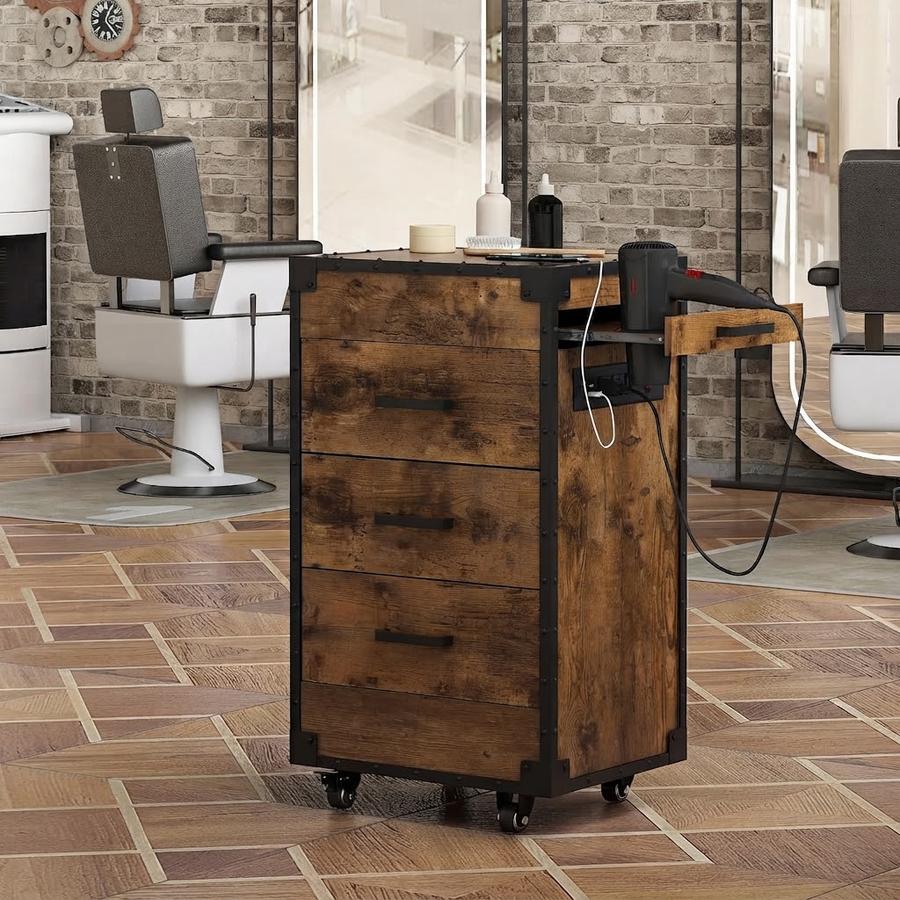
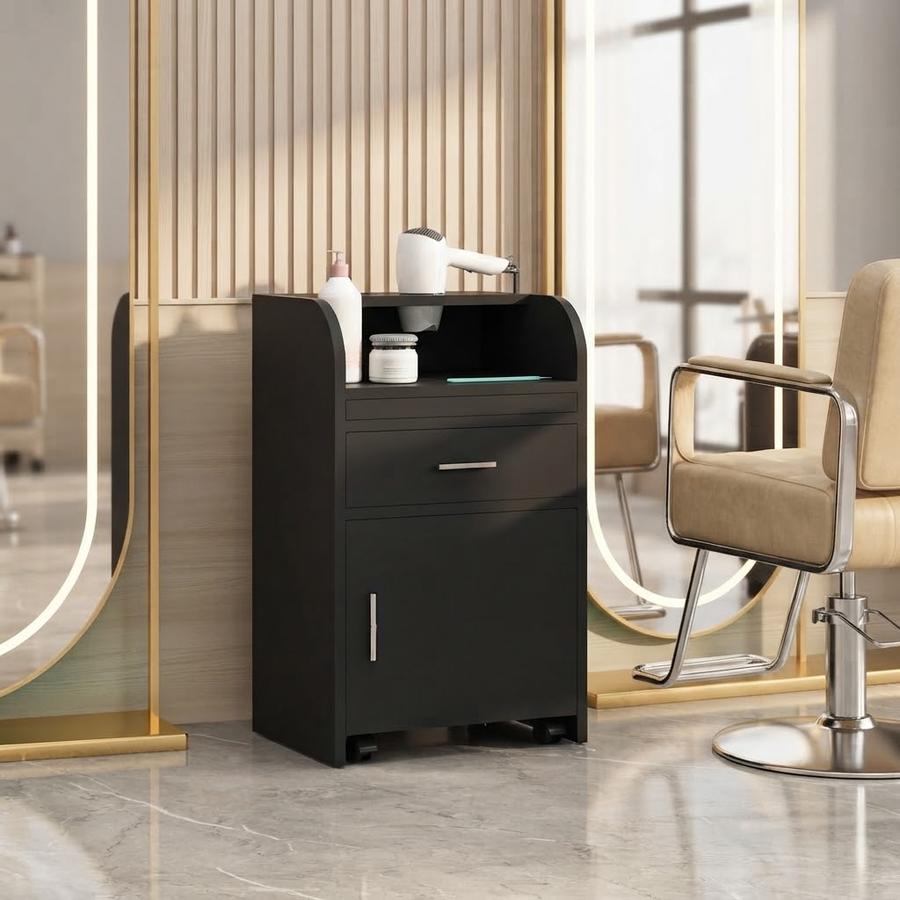
Roll a full booking day beside the chair: 110.2 lbs of rated capacity across three drawers and a pull-out tool tray. The tray carries three dryer holes and pushes back in when the service ends, clearing a 32-inch doorway. Three 3-prong outlets and two USB ports ride the frame on one 6 ft cable. The dryer plugs into the cart, and the cart plugs into the wall once. Where a stacked salon bag dumps on the floor at every chair change, these drawers hold their order. Buyers rate it 4.2★ across 42 reviews.
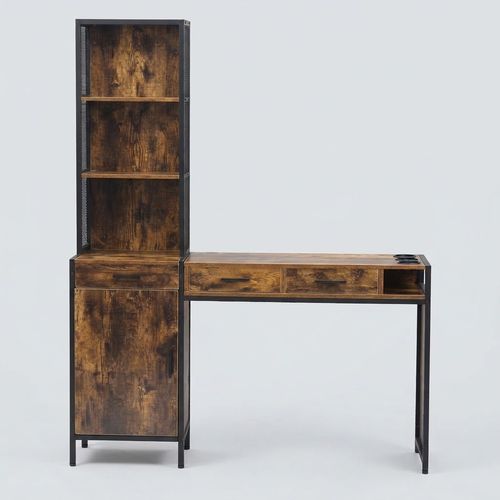
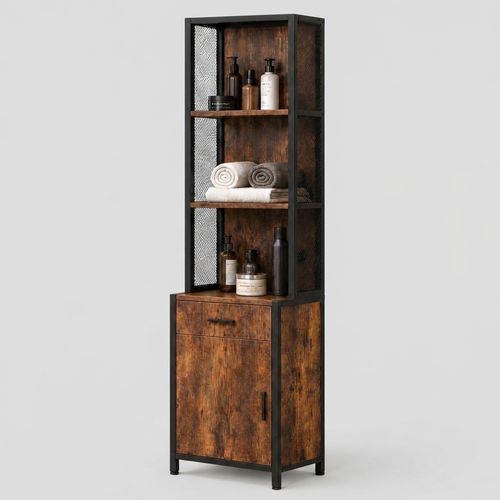
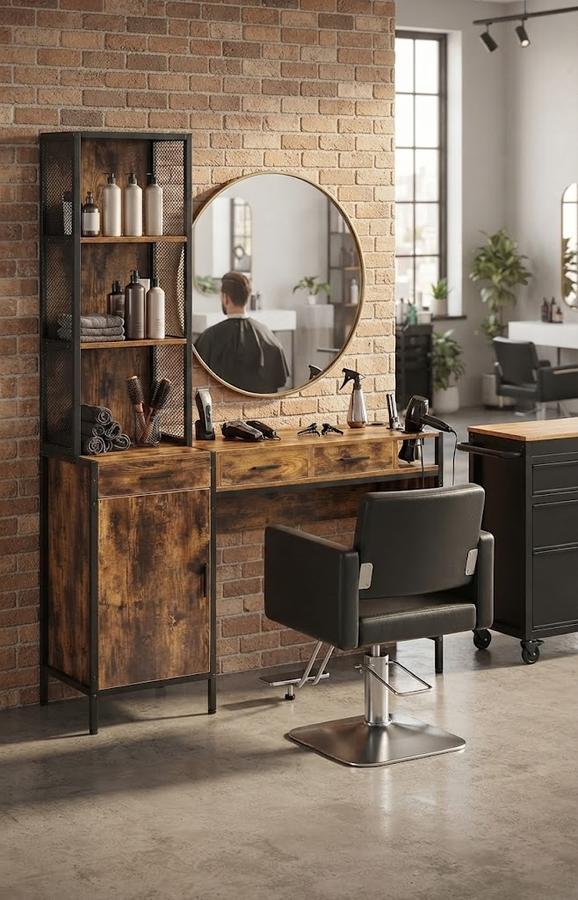
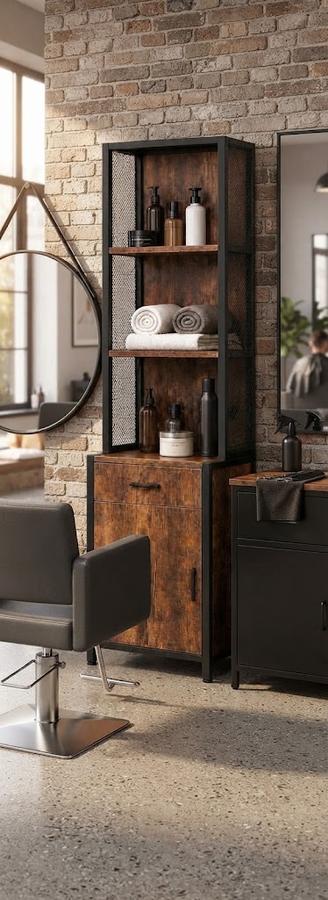
Stand this one against a wall you are not allowed to drill: no bracket, no anchors, four adjustable feet leveling 57 lbs on an uneven floor. Open shelves across the top tiers hold shampoo and conditioner where you grab them one-handed. The drawers and closed cabinet below keep backstock out of the hair dust. Melamine over thick P2 MDF wipes down after a color splash, and iron wrapping runs both sides. Where a wall-mount unit needs a landlord’s sign-off, this one needs a flat patch of floor. Owners rate it 4.3★ across 25 reviews. Try the footprint inside the 30-day return window.
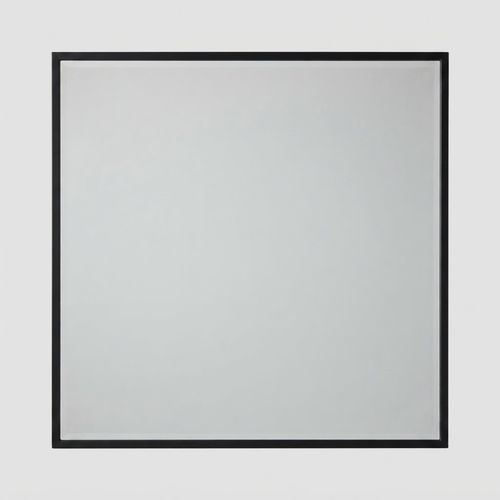
Hang a 33-inch mirror over the station and the wall above your tabletop stops looking half-finished. The back builds on a 12mm density board with premium hooks and two expansion screws included, so one adult levels it without a second pair of hands. Ground edges keep fingertips off raw glass during cleaning, and the surface wipes clear of hairspray film with a damp cloth. Foam and tape hold the glass still in transit. This is the pairing piece rather than storage, and it hangs beside any station format. Buyers rate it 4.5★ across 22 reviews, the highest rating here.
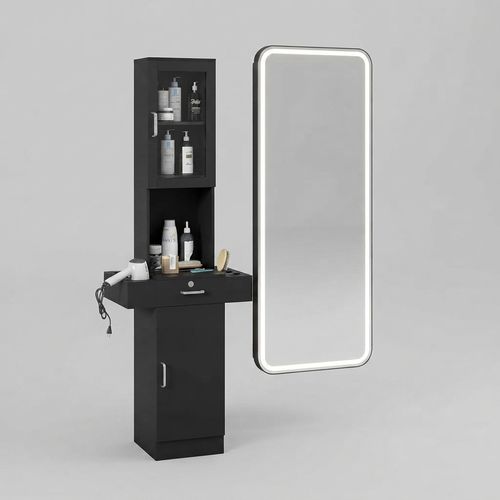
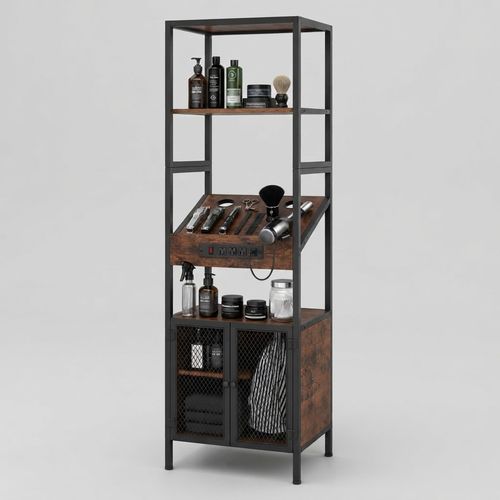
Line a retail row up where clients can see it: every tier of this freestanding cabinet holds 44 lbs. The top three sit open at eye level. Below them, mesh cabinet doors show what is inside while keeping hair dust off the stock, and one shelf slides to a new height when a tall bottle will not clear. Three 3-prong plugs and two USB ports sit on the frame with a 5.77 ft cable, so a dryer charges where it lives. Where an open rack leaves backstock coated by Friday, the mesh doors keep it clean. Rated 4.6★ across 29 buyer reviews.
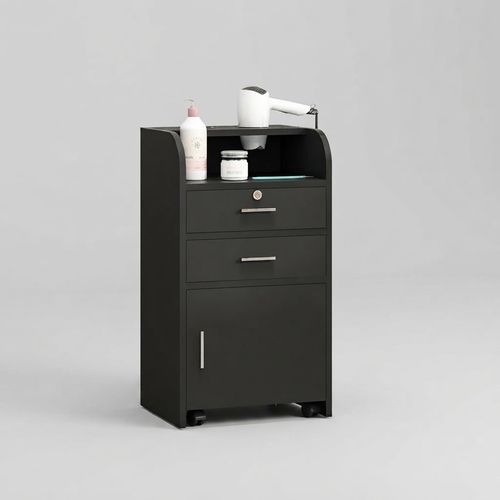
Park a compact cart in the gap between a chair and a wall: this trolley sits 17.7 by 13.8 at the base and stands 31.5 tall. Four swivel casters roll it across tile and two of them lock, so it holds still through a fade. Panels build up from 15mm P2 particle board backed with 3mm MDF, and the ventilated drawer front lets a warm dryer breathe instead of steaming inside a sealed box. Three top-panel holsters take standard dryers and irons, and the top drawer keys shut over your shears. Newest of the rolling formats with no buyer reviews yet: check the lock and the roll inside the 30-day return window.
Weigh a listing against the numbers RESHABLE prints before you order: pounds per tier, hours to build, outlets, and locking casters.
| Number | What it gets you | Where the gap sits | Source |
|---|---|---|---|
| 66 / 44 / 22 lbs | Set a dryer and a full retail row on the tabletop and the rating reads 66 lbs. Each level below it carries a separate printed line, so a stylist assigns tools by weight on build day rather than after a shelf sags. | Scan a typical listing for five minutes and one blanket rating still covers the whole unit. You finish the page without knowing whether a 4 lb dryer belongs on the tabletop or in the 22 lb drawer. | manufacturer spec sheet |
| 4.2★ / 277 reviews | Stylists running daily client shifts rate these stations 4.2★ across 277 verified buyer reviews. Owners post those ratings after months of loading real shelves, not after one 10-minute showroom walk-through. | Open a private-label furniture page and the review count rarely clears three digits. | 277 verified buyer reviews |
| 3 to 4 hours | A first-time builder opens pre-labeled hardware bags, works down the printed manual, and stands the station up in roughly 3 to 4 hours. | Read three buying guides before you order and each one warns that assembly takes a while. Not one blocks out an evening for you or names the hour count. | verified buyer reviews and the assembly manual |
| 3 outlets + 2 USB, 6 ft cable | Plug a dryer and a curling iron into the rolling trolley at once. One 6 ft cable runs to a single wall outlet, so no extension cord crosses your floor. | Count the outlets named on a competing product page and you usually reach zero. Nobody prints the cable length, so you learn it the day an extension cord crosses your floor. | manufacturer spec sheet |
| 4 casters, 2 locking | Roll the trolley to the chair on four swivel casters, then drop two brakes with your shoe to hold it steady through a 40-minute process. | You read ‘rolling wheels’ on every buying-guide checklist and never a brake count. The cart drifts mid-service before you learn how many casters actually lock. | manufacturer spec sheet |
| 15mm board + 3mm MDF | Press a palm against the trolley’s side panel: 15mm P2 particle board backed with 3mm MDF. The panel holds a full shift of tools without flexing. | Guides tell you to knock on a panel and check for wood or composite. None prints a millimeter thickness, so you cannot tell 15mm from 9mm before the box lands on your floor. | manufacturer spec sheet |
The moments a station earns its keep: a cart locked mid-color, a hot iron parked, 110 lbs loaded.

A color service pins you beside the chair for 40 minutes, and a cart that drifts costs you the reach. The RESHABLE Rolling Salon Trolley glides on four swivel casters until you drop two brakes with the side of your shoe. Bowl, brush, and foil packet hold their spot by your elbow until the timer goes.

A curling iron leaves a client’s hair at working heat and needs somewhere to sit for the next 20 minutes. The black wall-mount station carries six Heat-Resistant Tool Holders cut in two widths. A fat dryer barrel and a slim flat iron each drop into a hole sized for it. Nothing cools on the wood surface.

Weigh a gallon of developer, a clipper case, and a dozen color tubes before you decide which tier takes what: the brown wall-mount station prints 66 lbs on the cabinet top, 44 per shelf, 22 per drawer. Underneath, iron tube framing carries an 89 lb body, so the top does not dip when you lean a knee on it during the mount.

One rolling trolley carries 110.2 lbs across its frame, enough for a full booking day of tools and retail stock. Three drawers take capes, clips, and razors while the side tray holds the dryer. Roll the whole load from the cutting chair to the processing corner in one trip instead of two armfuls.

RESHABLE sits in the entry-to-mid tier of salon storage, and the honest pitch is a spec sheet, not an adjective. What that tier costs you shows up in month four, when a loaded drawer starts to rack. Buyers rate these stations 4.2 stars across 277 verified reviews. Whichever name a page hangs on it, hair styling storage cabinet or salon barber station, you are looking at the same iron-framed furniture in the Spa Storage Systems category. Hang a wall-mount unit over the chair, roll the trolley to it, or level the freestanding cabinet beside a mirror cut to match. A cosmetology student who lived out of a stacked school bag swapped it for the rolling trolley: three drawers, a keyed top one, 110.2 lbs of rated capacity. Nine months in, the top drawer still locked and nothing had rattled loose from the frame. Two years later the same cart rolled into a first salon job. A bag holds the same tools and loses them on the floor at every chair change. Check the drawer lock and the shelf level the day you build. Set it up in the corner it will live in on day one; the retailer’s 30-day window is your out if it does not fit.
You pick the format your room allows. Bolt a wall-mount station over the chair, stand a freestanding cabinet against a wall you cannot drill, or roll a trolley between chairs. Every station publishes what each tier of it carries. You check that load against your own clipper case instead of trusting an adjective.
How this brand startedUnbox, build, mount or position, then load: a first flat-pack build runs roughly 3 to 4 hours.
Every bag arrives pre-labeled, and sorting them into build order takes about 20 minutes before the first screw goes in.
Plan 3 to 4 hours for a first build, with a screwdriver and a clear patch of floor.
Wall units hang on bracket screws, freestanding levels on foot mats, trolleys lock two casters.
Load shears into the top drawer, drop the dryer into its holder, and stand retail bottles on the open shelf before your first client.
Owners write about build hours, locked drawers, and holes that needed a redrill; these run verbatim.
This stand completed the look for my in home salon space. I had hair stuff all over my room and now, it all has a place. My only issue is the door at the top seems to be slightly off but that may be due to my handy skills, not necessarily the product.
These stations were perfect for my salon suite. They took about 3-4 hours to assemble (because i purchased 3). Has a lot of storage, easy to clean & overall really good quality.
This system was easy to install. It has great storage space for everything. Blow dryer, curling iron and clippers all have a place.I would recommend.
This is a great work station for my Studio salon. It looks exactly like the picture! The only issue and why I’m leaving a 4 star is because the door handle holes were located on the wrong side. Had I not paid to have someone put it together I couldn’t have used it at all. Since I paid for it to be put together I had to pay additional money to have him drill new holes on the correct side so the door handle could be attached properly which I didn’t appreciate.
Really nice, love the locking drawer. Clean lines adds Zen for me. Extremely decent quality fit the price. As a professional stylist, this is the same quality as in salon. I used it for my walk-in closet/dressing room.
I purchased this cart for my tiny salon.It works great, the wheels can lock and it has extra plug-ins and USB ports. I use the drawers for capes and curling irons. I like it a lot.
Nice cart for the money. Easy assembly. I Am enjoying this piece in the salon and would recommend buying.
Happy with purchase, but in assembly, several holes did not line up properly. Still managed to come together and can recommend as long as you understand the possibility that misaligned screws/holes may happen to you too. Great look once put together, and works well for an at-home basement barber stand.
Took me about 3 hrs to assemble as a not so smart and handy person. Everything was complete and fit perfectly. The hardware is good quality and smooth. I use it for personal use in my small 1 bedroom apartment and I love it thus far. Came quickly as well
RESHABLE buyers open the box worrying about misaligned holes and a top that rocks under a dryer; here is what actually happens.
Cords from a dryer, an iron, and a phone charger cross your walkway by 10 a.m. Plug the cart into the wall once and all three land on its three 3-prong outlets and two USB ports, fed by a single 6 ft cable.
Walking room in a 60-square-foot suite disappears one cart at a time. Bolt a wall-mount station above the chair and a cart no longer parks between you and the mirror.
One key turn before lunch keeps your shears in the drawer instead of in a classmate’s kit. The lock is sized for shears, clippers, and a phone, which covers the kit a cosmetology student cannot replace mid-term.
Stack the dryer you already own onto the shelf and the 44 lb line tells you in advance whether it fits. Buyers on several units report pre-drilled holes off by a few millimeters, fixable with a redrill but worth an extra hour.
Assembly alignment issues appear in verified reviews on 4 of 9 units
A screw still goes missing on some builds, and you find out at hour two with the frame half up. Email support that evening and replacement hardware ships without packing the whole cabinet back into its box. If the unit lands damaged or the footprint fights the room, the 30-day return window through the retailer covers it.
Two-year frame, 30-day returns through the retailer — pick a format to compare specs.
The cart earns its keep on locker day, through a 40-minute color, and in the spare room you converted last spring.
You wheel the trolley out of the locker room at 8 a.m. with three drawers loaded. The keyed top drawer stays shut beside a shared bench all afternoon.
Bowl, brush, and foils roll with you from the cutting chair to the processing corner in one trip. Two brakes drop and the cart stops drifting for the full 40 minutes.
A wall-mount station bolts over the single chair in a 10 by 10 room. The floor beneath it stays clear, so a client can swing their feet through a 90-minute balayage.
Your neighbour’s cart already owns the walkway by 9 a.m. on a Saturday. A freestanding cabinet levels on four foot mats and keeps 44 lbs of shelved stock on your side of the lane.
Two dryers and an iron plug into the cart between back-to-back bookings, and the heat holders take them hot without scorching the top panel.
Day 1 runs 3 to 4 hours with a screwdriver, and by year two the same frame still holds your tools.
Cut the tape after close, sort the pre-labeled hardware bags across the floor, and work the printed manual for 3 to 4 hours. Test the drawer lock the same evening. A wrong fit goes back inside the 30-day return window through the retailer.
Your shears settle into the top drawer and the dryer into its holder, so a cut-and-style stops costing you two walks across the room.
Locking casters and adjustable foot mats hold the setting you gave them through a month of daily rolling and loaded top drawers.
The trolley that rode a school locker room follows a cosmetology student into a first salon chair, drawers still tracking straight.
Ready for Day 1? Pick the format your floor plan allows, then check today's price.
A salon station is the dedicated storage and work surface beside a styling chair: a tabletop for tools, drawers for shears and clips, and holders for heat tools. RESHABLE builds three formats of it. A wall-mount salon storage cabinet hangs off the wall, a freestanding cabinet stands on adjustable feet, and a rolling trolley moves between chairs on four casters.
A wall-mount station bolts to studs or anchors and leaves the floor beneath it clear, which matters in a suite you rent by the square foot. A freestanding cabinet stands on four adjustable feet and needs no drilling, so it suits a lease that bars wall work or a room you plan to leave within the year. Both formats carry the same 66 lb tabletop and 44 lb shelf ratings. The real difference is who holds the weight, your wall or your floor, and whether you want the closed lower cabinet that a wall unit trades away for depth.
Floor area decides it. Under roughly 60 square feet, the wall-mount unit wins, because the walking lane beneath it stays open and a client can still swing their feet at the chair. Freestanding wins when you cannot drill, when you expect to move within a year, or when you want closed cabinet storage that a wall unit gives up for depth.
Four things carry a shift. A work surface rated for the weight you actually set on it, at least one lockable drawer, heat-resistant holders for the dryer and irons, and drawer volume for capes and clippers. Power access moves from nice to necessary the moment you run two heat tools off one spot. The rolling trolley covers that last one with three 3-prong outlets and two USB ports on a 6 ft cable, so the cart plugs into the wall once and every tool plugs into the cart.
One per chair is the working rule, since a shared station costs both stylists walking time between clients. A shop running two chairs on staggered bookings can share a single freestanding cabinet for retail backstock while each stylist keeps a rolling trolley for personal tools. A keyed top drawer is what makes that shared arrangement hold up past the first month.
Weight rating per tier. Buyers check the tabletop and never ask what an open shelf carries, then load a row of liter-size conditioner onto a tier that was never rated for it. These stations print 66 lbs for the cabinet top, 44 lbs for each shelf, and 22 lbs for each drawer, so the check costs you one glance.
Salon storage splits into three broad tiers: entry-level compact carts and light wall units, mid-tier stations with lockable drawers and heat holders, and flagship builds with iron tube framing and full per-tier weight disclosure. RESHABLE sits across the entry and mid tiers with one flagship wall station. Pricing moves, so check the current listing for the format you want.
Rated limits run 66 lbs on the cabinet top or tabletop, 44 lbs on each open shelf, and 22 lbs in each drawer. The rolling trolley is rated differently, at 110.2 lbs across the whole frame. Weigh what you plan to store: a gallon of developer runs near 9 lbs, and a clipper case with guards runs 3 to 5.
The wall-mount tabletop is rated to 66 lbs, well past a dryer, two irons, and a full retail row. Wobble in practice traces back to the mount rather than the top. Buyers who reported flex had set anchors in bare drywall with no stud behind them. Hit two studs on the bracket line, or use heavy toggle anchors rated past the combined load.
Each open shelf is rated 44 lbs. A liter conditioner bottle weighs roughly 2.4 lbs full, so a row of twelve lands near 29 lbs and stays inside the rating with room left. Sagging turns up when a buyer stacks sealed backstock cases on a display tier. Case stock belongs in the closed cabinet below.
Clippers, guards, shears, and a working retail row land well under 44 lbs, so the shelf tier handles a barber's daily kit without trouble. Move up to the 66 lb tabletop when a professional dryer, a gallon jug of developer, and a full retail display all share one surface. Split the load across tiers rather than piling one.
For a converted spare room, the compact rolling trolley takes a 17.7 by 13.8 inch footprint and rolls out of the way between clients. The lightest wall unit spans about 23 inches of wall and claims no floor at all. Skip the 50-inch flagship wall station unless you have a full wall to hand it.
Drawer count runs from one on the lightest wall unit to three on the flagship wall station and the larger rolling trolley. A key lock sits on the top drawer of several units, sized around shears, clippers, and a phone. Check the drawer count on the unit you are looking at, since the formats differ.
The rolling trolley carries three 3-prong outlets and two USB ports on one 6 ft cable, and two heat tools at once is the design case. The limit is your wall circuit rather than the cart. A 1875W dryer plus a 200W flat iron sits inside a standard 15-amp circuit; two full-power dryers on that same circuit will not.
A single station rarely does. A professional dryer draws most of a 15-amp circuit on its own, so trouble starts when two stations share one wall circuit and both dryers run at once. Feed each station from a different circuit where the building allows, and plug the 6 ft cable straight into the wall rather than into a chain of power strips.
Holder count varies by unit. The black wall station carries six holders cut in two widths, the flagship brown station carries three built into the countertop, and the compact trolley carries three holsters on its top panel. Wide holes take a dryer barrel, narrow ones take flat irons and clipper heads.
Bodies run P2-grade MDF or high-density particle board under a wipe-clean melamine or painted surface. The load-bearing formats add iron tube framing at the sides and corners. The compact trolley builds from 15mm P2 particle board backed with 3mm MDF. Handles come in aluminum or metal, and the heat holders are moulded ABS.
Assembled weight runs from 30 lbs on the lightest white wall unit to 89 lbs on the flagship brown wall station. The larger rolling trolley lands at 53 lbs, the freestanding cabinets at 52.6 and 57 lbs, and the wall mirror at 21.5 lbs. Plan a second pair of hands for anything past 50 lbs going onto a wall.
Four swivel casters carry each rolling unit, and two of them lock. Drop both brakes before a fade and the cart holds its spot. Leave them open and it rolls freely across tile.
No warranty term is published for these stations, so treat the retailer's standard 30-day return window as your coverage and use it deliberately. Assemble inside that window instead of leaving the box sealed for a month. Check the drawer lock, the caster brakes, and the shelf level while a return is still open to you.
Dry-fit the panels before driving a single screw, and start every screw loose so the body can shift a few millimeters into square. Buyers on several units report pre-drilled holes off by a small margin. Most worked around it by loosening the neighbouring screws or opening one hole with a 3mm bit. Contact support if a whole panel misses.
Hardware ships pre-labeled bag by bag, and the manufacturer lists a direct support contact for replacement parts, which beats a full return over one screw. Photograph any damage the day the box lands. For a cracked panel or a bent frame, the 30-day return window through the retailer is the cleaner route.
No certification is published for these units, and none should be assumed for the charging outlets on the rolling formats. If local code requires listed electrical fittings in a commercial shop, plug the cart into a properly rated wall outlet and have an electrician review the circuit rather than relying on an unstated rating.
Stations ship flat-packed, one carton per unit, with panels foam-wrapped and hardware pre-labeled. Delivery timing comes from the retailer rather than the manufacturer, so the current estimate for your address shows on the product page. The mirror ships fixed in foam with tape across the glass. Inspect every edge before you carry the box inside.
The 4.2★ average covers 277 verified buyer reviews across the rated units, which means each one comes from a confirmed purchase rather than an open comment form. Ratings per unit run from 4.0★ to 4.6★. One newly listed trolley carries no reviews yet, and it stays out of that average rather than being padded into it.
These stations sell online through the retail listing linked on each product card here. Pricing and stock move, so the card sends you to the live listing rather than quoting a figure that ages. Check the current price and the delivery estimate before you commit to a format.
Studs are the safe answer for a unit holding 66 lbs of tools plus its own 30 to 44 lbs of body weight. Find two studs behind the bracket line and drive into them. Where the studs miss the bracket holes, use heavy toggle anchors rated well past the combined load, and skip plastic drywall plugs entirely.
The rolling trolley is rated at 110.2 lbs across the frame, which covers capes, clippers, shears, brushes, a color kit, and a dryer for a full booking day. Three drawers plus a pull-out tray sort them so you are not digging mid-service. Retail backstock is the exception; that belongs on a freestanding cabinet.
Both rolling formats clear a standard doorway assembled. The larger trolley measures 18 inches deep by 14 wide, and the compact one 17.7 by 13.8, both well inside a 32-inch opening. Push the side tool tray in first so nothing catches the frame on the way through.
Most school lockers will not take a station cart. They are sized for a bag, not for furniture standing 31.5 inches tall. The compact trolley parks in a locker room rather than inside a locker, which is why the keyed top drawer matters more than the footprint for a cosmetology student.
A rolling trolley suits a home business better than a fixed station, because it leaves the living space between clients. Park it beside the chair during a service, brake two casters, then push it into a closet afterward. The keyed drawer keeps shears away from a household with kids in it.
These trolleys move within a building, not between them. At 53 lbs assembled with no folding frame, the larger cart is not a travel case, and repeated disassembly loosens flat-pack joints. A traveling stylist does better keeping the cart at a home base and carrying a soft kit to guest chairs.
Hang a wall-mount station over the chair and add nothing to the floor. The 42-inch wall unit projects 9 inches off the wall, keeps two drawers and five holders within a half-turn, and leaves the walking lane clear. Add the compact trolley later only if drawer space runs out.
Narrow hallways favour the compact trolley at 13.8 inches wide. Both rolling formats turn in place on swivel casters instead of needing a wide arc. Keep the pull-out tray closed in transit.
Top drawer for what you touch every client: shears, clips, a comb, a razor. Middle drawer for section tools and color brushes. Bottom for capes and towels, which are bulky but rarely urgent. That order keeps your most-used kit a half-turn from the chair, and the 22 lb drawer rating keeps you honest about what goes up top.
A keyed drawer stops casual borrowing, which is the real problem in a shared room: a classmate taking shears for one client and not bringing them back. It is not a safe, and a determined thief with a screwdriver defeats any flat-pack lock. Keep shears in the locked drawer and your kit list on your phone.
A cart follows the chair; a station anchors it. The trolley wins for color work and for a floor where you move between chairs, carrying 110.2 lbs on locking casters. A wall or freestanding station wins on total storage and display, since it uses vertical wall run a cart cannot reach. Plenty of stylists end up owning one of each.
The compact cart gives you a 17.7 by 13.8 inch footprint, two drawers, a cabinet, and three dryer holsters at 31.5 inches tall. A full-size station adds a 66 lb tabletop, open display shelves, and a closed cabinet in a body running near 70 inches tall. Storage volume is what you trade floor space for.
Open shelves suit retail you want clients to see and product you grab one-handed mid-service. Cabinet doors suit backstock, towels, and anything hair dust ruins by Friday. The freestanding cabinet splits the difference: open tiers up top, mesh doors below, and one shelf that reseats at a new height for tall bottles.
A bag holds the same tools and loses them on the floor at every chair change. A trolley keeps three drawers in order, rolls with you between practice chairs, and locks the top drawer while you are at lunch. Students who bought one report using it two years straight and carrying it into a first salon job.
One is enough to start, and your floor decides which. Work one chair in a fixed spot and the station wins outright. Move between chairs or process color at a back wall and the cart wins. Add the second piece when storage, not mobility, becomes the thing slowing you down.
The 33-inch mirror ships in a black frame and hangs beside any format here, so it is a standalone purchase rather than half of a matched set. Station photos pair it with the black units most often. Measure the wall run above your tabletop first, since the glass needs 26 inches of width.
Plan 3 to 4 hours for a first build, based on owner reports rather than a marketing estimate. Hardware arrives pre-labeled bag by bag with a printed manual. Dry-fit each panel and start every screw loose before tightening anything, which is the step that saves an hour when a hole sits slightly off.
Hair stops a salon caster long before wear does. Tip the cart every few weeks, cut the wrapped hair off the axle with shears, and wipe the wheel down. A drop of light machine oil at the swivel bearing kills a squeak. Leave the brakes released when the cart sits, so the pads do not take a set.
A damp cloth handles melamine and painted board, which is what these bodies use. Skip abrasive pads and solvent cleaners; both cut the finish and open the board edge to moisture. Wipe a color or developer splash immediately instead of letting it sit, and dry the surface after. Standing water at a panel seam is what swells particle board.
Binding usually means an overloaded drawer or a body pulled out of square, not a broken slide. Empty it, check that the load stays under the 22 lb rating, then loosen the screws on the surrounding panels, square the body, and retighten. If a runner is bent, ask support for a replacement rather than forcing it back.
Tipping comes from a high load with an open drawer, not from the frame itself. Keep the heaviest items in the bottom drawer and the light kit up top, and close a drawer before pushing the cart. Brake two casters during service. On a freestanding cabinet, level the four feet so the weight sits evenly.
Damp towels are the usual culprit. Dry them fully before they go in, leave a finger of air between stacks, and crack the doors overnight in a humid shop. A mesh-door cabinet breathes better than a solid panel. Wipe standing water off a shelf edge, because swollen board never goes back flat.
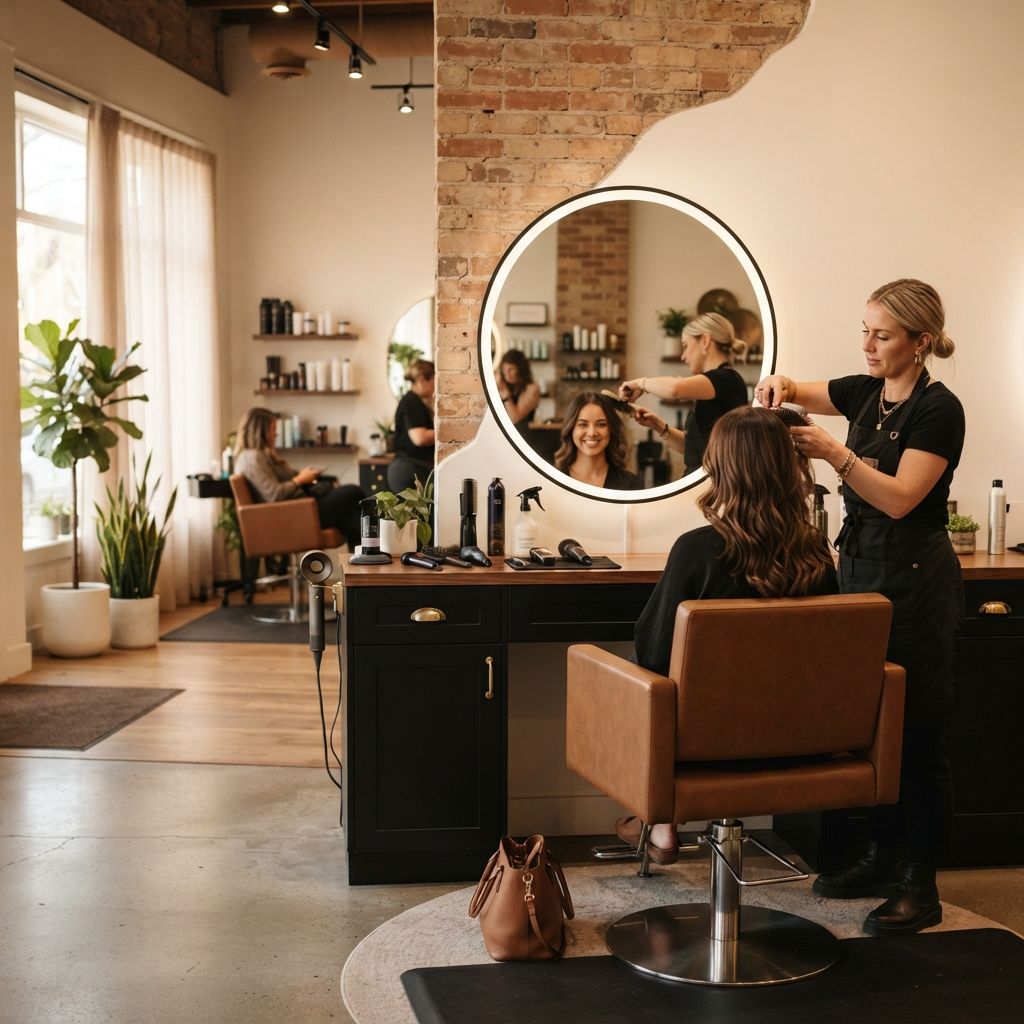
Wall-mount over the chair, freestanding against the wall, trolley between chairs: the same tools, three places to put them.
Get the RESHABLE Salon Station Buyer’s Guide plus new-model and restock alerts.
No spam. Unsubscribe anytime.